
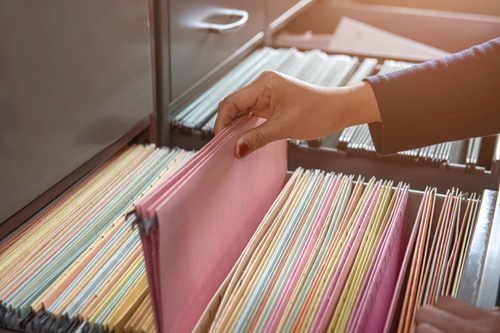
 Filing cabinets rank among the heaviest and most awkward items in any office, and packing them the wrong way can bend the frame, jam the drawers, or scatter paperwork across the truck. In most cases, you should empty a filing cabinet before an office move, though how much you need to remove depends on the cabinet’s construction, drawer count, and how far it needs to travel. Wide, lightweight lateral cabinets almost always need to be cleared out completely, while narrower vertical cabinets can sometimes make the trip with a few drawers still loaded.
Our team at CRS Moving & Storage has handled moves of all sizes and types across New York City, Long Island, New Jersey, and our newer Los Angeles and San Diego markets, and filing cabinets come up on nearly every office job. Because every company organizes its records differently, we walk you through which cabinets can stay loaded and which ones need to be packed out before moving day, so files stay organized and cabinets arrive undamaged.
Do You Always Have to Empty Filing Cabinets Before an Office Move?
The answer depends heavily on how the cabinet is built. Filing cabinets vary widely in frame thickness, drawer count, and overall weight distribution, and a cabinet that travels safely full in one configuration can bend or jam in another. Our team typically sorts cabinets into two broad categories before deciding how much needs to come out.
Two-Drawer and Narrow Vertical Cabinets
Narrow, two-drawer vertical cabinets are usually the sturdiest of the group. Their compact frame and lower center of gravity mean they can often make a short move fully loaded, as long as the drawers latch securely and the cabinet is not dragged or tipped during transport. Securing the drawer mechanism before the truck arrives can potentially prevent files from sliding forward every time the cabinet shifts.
Four-Drawer and Wide Lateral Cabinets
Wider four-drawer and lateral cabinets are a different story. Their frames are typically built with lighter-gauge metal to keep the unit affordable, which means a fully loaded cabinet can flex or bow during a move and never sit level again. As a general rule of thumb, the bottom three drawers of a four- or five-drawer unit can often stay loaded, while the top two must be emptied and packed separately to keep the frame from bending. Wide lateral cabinets, because of their especially light construction, should be emptied completely before moving day.
Credenza-Style, Flat-File, and Medical Filing Cabinets
Beyond standard vertical and lateral cabinets, many offices contain credenza-style filing units, flat-file cabinets used by design and architecture teams, and specialized medical filing systems. Each presents its own handling requirements.
Credenza-style cabinets, which are long and horizontal and sit at desk height, must always be emptied completely before moving. Their construction distributes weight across a wide frame that was not designed to bear load during transport. Even a partially loaded credenza can bow or twist when it is tilted, slid, or carried, and the damage is often not visible until the drawers are opened at the new location.
Flat-file cabinets, which store large-format drawings, prints, and documents in shallow horizontal drawers, must be emptied before any move regardless of the distance involved. The wide, shallow drawers offer almost no structural support when loaded, and the documents themselves can be permanently damaged if the drawers shift during transport. Each document should be rolled or folder-protected before boxing, with the boxes labeled clearly by project or department.
Medical filing cabinets, particularly those used in clinical settings for patient records, require the same empty-and-box approach as lateral cabinets, with the additional step of maintaining HIPAA-compliant handling throughout the process. If your office move involves medical records, our secure records storage service provides a compliant solution for files that are not yet ready to travel to the new location.
What About Desk Drawers?
Desk drawers are a frequently overlooked part of office move preparation. Unlike heavy filing cabinets, the concern with desk drawers is not structural damage to the desk, but the loss or scattering of small items during transport. Pens, paper clips, USB drives, and personal items move around inside drawers when the desk is lifted, tilted, or loaded onto a truck, and they can jam the drawer mechanism or spill into the truck if the drawers are not secured. As a general rule, empty desk drawers of any loose small items before moving day, even if your movers will tape the drawers shut. Pack the contents in a labeled bag or small box that travels with the desk so nothing is misplaced during the move.
What Can Happen When You Move a Full Filing Cabinet
Moving a cabinet without checking its construction first is one of the more common ways an office ends up with damaged furniture on move-in day. A frame that bows under the weight of packed files rarely returns to its original shape, and drawers that jam from a bent track can become unusable for good.
Full cabinets also shift the balance of the entire piece, making it easier for a drawer to slide open unexpectedly or for the unit to tip during transport, especially on a hand truck or in a freight elevator. Once a cabinet reaches its new location, we recommend securing it to the wall or to an adjacent unit before refilling the drawers, which can help prevent tip-overs in a busy office.
How to Organize and Pack Office Files for Your Relocation
If your cabinets do need to be emptied, the way you pack the files matters just as much as emptying them in the first place. A clear system on the way out saves hours of searching on the way back in.
Choosing the Right Boxes and Protective Materials
The right container protects paperwork from moisture, tearing, and shifting inside the truck. Before you tape a single box shut, keep the following in mind:
- Use a file-rated box: a banker box or file-rated carton holds up better under the weight of paper than a standard moving box.
- Watch the weight: keep each box light enough to carry safely, generally no more than about 30 pounds, so it stays intact and easy to handle.
- Protect sensitive files: wrap water-prone or confidential documents in plastic before boxing them, particularly during wet weather.
Sealing each box completely, rather than leaving the lid folded shut, keeps files from shifting or spilling if a box gets tipped on its side.
Labeling Files by Cabinet and Drawer
Removing your files in order and labeling each box with the cabinet and drawer it came from makes it far easier to arrange everything properly once you move into your new office, even on a multi-floor office relocation. Numbering cabinets and matching that number to the boxes pulled from them is a simple system that holds up well across departments. Our team can help assign that numbering system before the first box goes out the door, so unpacking at the new office can take hours instead of days.
Deciding Which Records to Keep, Store, or Digitize Before You Move
Emptying a filing cabinet is also a natural point to decide what actually needs to make the trip. Records that have outlived their useful life take up truck space and cabinet room in the new office for no reason, so many businesses use a move as the trigger to get rid of anything you don’t need.
The University of Wisconsin-Madison’s Archives and Records Management program, which guides departments through building moves and consolidations, recommends checking files against a retention schedule before deciding what to pack, since records that have not reached the end of their retention period may still need to be kept rather than tossed out. The same guidance suggests keeping packed record boxes light enough to carry safely and labeling each one by the space or cabinet it belongs in before it ever leaves the building, according to the university’s guide to managing records during an office relocation.
For records you are not ready to part with, off-site storage keeps them secure without crowding your new space. We offer secure records storage and long-term document storage for businesses that want their files off-site but still accessible, and if you are still weighing paper against digital, our post on weighing document shredding against digital archiving walks through how to make that call.
How CRS Moving & Storage Supports Your Office Move
However you decide to handle your filing cabinets and records, CRS Moving & Storage plans around them rather than treating them as an afterthought. Before moving day, our team reviews your cabinets in person or by photo, tells you which units can stay loaded, and supplies banker boxes, tape, and protective wrap for anything that needs to come out.
We also handle deciding whether to refinish or replace aging office furniture that may not be worth moving at all, so cabinets that are already showing wear do not have to make the trip unnecessarily. On move day, our crews load, label, and transport your files with the same care they give to server racks and reception furniture, and we can unload boxes directly into the cabinets and drawers you specify at the new office.
Ready to Plan Your Office Move?
CRS Moving & Storage has managed commercial relocations for more than 25 years, handling everything from single-floor office moves to multi-building corporate relocations across New York City, Long Island, New Jersey, and our Los Angeles and San Diego markets. Our crews are fully licensed and insured, and we supply the packing materials, labeling systems, and on-site planning that keep filing cabinets and records intact from the old office to the new one.
If your office move includes filing cabinets, records, or anything else that needs a careful hand, reach out and we can walk through your space before you pack a single box. Fill out our contact form to schedule a free consultation.
Frequently Asked Questions About Emptying Filing Cabinets Before an Office Move
Here are answers to a few common questions about packing and moving filing cabinets during an office relocation.
Do you need to empty every filing cabinet before an office move?
Not always. Narrow, two-drawer vertical cabinets can often make a short move fully loaded if the drawers latch securely. Wider four- and five-drawer units usually need the top drawers cleared to prevent the frame from bending, and lateral cabinets, because of their lighter construction, generally need to be emptied completely. Our team reviews your specific cabinets before moving day and lets you know exactly what needs to come out.
What is the difference between moving a two-drawer cabinet and a four-drawer cabinet?
Two-drawer vertical cabinets sit lower and carry less weight, so their frames can usually handle a full load during a short move. Four-drawer cabinets are taller and are often built with lighter metal to keep costs down, which means a fully loaded unit can bow or lean once it is tilted onto a dolly. Emptying the top two drawers before moving day helps the frame stay square during transport.
Can a filing cabinet get damaged if it is moved while it is still full?
Yes. A full cabinet that was not designed to travel loaded can bend at the frame, jam its drawer tracks, or pull the handles loose from the bolts that hold them. Once a cabinet warps, it may not sit level again, and a jammed track can potentially make a drawer unusable. Emptying cabinets that are not rated to move full is one of the simplest ways to avoid this kind of damage.
What should you do with files you no longer need before a move?
An office move is a practical point to sort through old paperwork and get rid of anything you do not need before it takes up space in your new location. Check records against your retention requirements first, since some files may still need to be kept even if they look outdated. Anything you are ready to part with can typically be shredded or recycled rather than packed and moved again.
Should records be stored on-site or off-site during an office relocation?
It depends on how often your team accesses those files. Documents you reference regularly usually make more sense on-site in your new office. Records you rarely open, or files you are required to keep but do not need close at hand, can often move into secure off-site storage instead, which frees up cabinet and floor space without requiring you to get rid of anything you might need later.